
Alright, settle in, grab your imaginary latte, because we're about to demystify one of the coolest materials known to humanity: carbon fiber. You see it everywhere – sports cars, airplanes, fancy bikes, even high-end fishing rods. It’s got that sleek, futuristic look, that whisper of impossible lightness and unbreakable strength. But have you ever stopped to think, "What on earth is this stuff actually made from?"
Most people picture something incredibly rare, perhaps mined from a secret alien meteor crater, or synthesized in a lab by scientists wearing glowing hazmat suits. The truth? It’s far more mundane, and frankly, a bit funnier. Prepare for a plot twist worthy of a Hollywood B-movie, because the secret ingredient to this space-age marvel is... wait for it... drumroll please... yarn!
From Humble Yarn to Super-Material? You Bet!
Yes, you heard that right. Not the yarn your grandma uses to knit you a slightly-too-itchy Christmas sweater, but something very, very similar. The primary precursor material for most carbon fiber is called Polyacrylonitrile, or PAN for short. Try saying that five times fast after a double espresso! PAN is basically a synthetic polymer, and guess what? It's the same family of stuff used to make acrylic yarn and fabrics.
Imagine showing up at a car show, pointing to a Ferrari with a gleaming carbon fiber chassis, and smugly announcing, "That, my friend, started its life as a relative of a throw blanket!" You'd probably get a few odd looks, but you'd also be absolutely, gloriously correct. It's like finding out Superman's cape is woven from recycled dish towels. Mind. Blown.
The Grand Transformation: Baking, Not Knitting
So, we start with this humble PAN yarn. It looks like ordinary white or off-white thread. But we don't knit it into a ridiculously expensive sweater for your super-strong, feather-light dog. Oh no. We put it through an absolutely brutal, molecular weight-loss program that makes the Atkins diet look like a cheat day.
First, it gets oxidized. Think of it like pre-baking. The PAN fibers are stretched and heated in air to around 200-300°C (390-570°F). This step is crucial because it rearranges the molecular structure, making it more stable for the next, even more intense, fiery trial. It basically locks those carbon atoms into position, preparing them for the ultimate cleanse.
Next comes the real magic, and by magic, I mean temperatures that would make a dragon sweat. The oxidized fibers are placed in an inert atmosphere (meaning no oxygen, otherwise they'd just burst into flames) and heated to an insane 1,000-3,000°C (1,800-5,400°F). We’re talking hotter than volcanic lava, hotter than most industrial furnaces, practically sun-surface temperatures!
The Molecular Diet: Losing Everything But Carbon
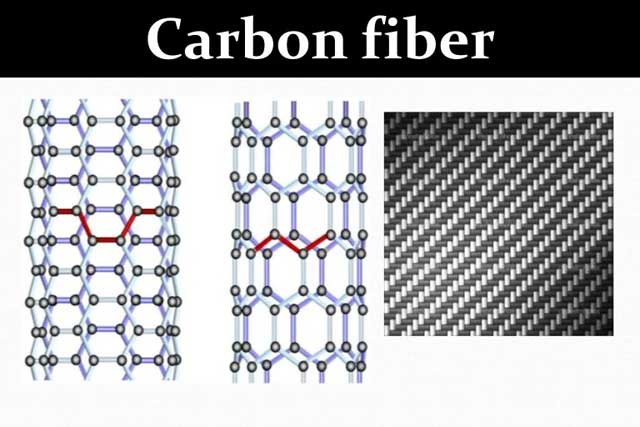
During this extreme heating, all the "impurities" – the hydrogen, nitrogen, and oxygen atoms – are literally cooked out of the PAN. They vaporize and leave the building, often with a smoky, rather pungent farewell. What's left behind? Pure, unadulterated carbon atoms. These carbon atoms then link up in long, hexagonal chains, perfectly aligned, forming tiny, incredibly strong graphite crystals. Imagine a bunch of enthusiastic carbon atoms holding hands in perfectly straight lines, refusing to let go.
/GettyImages-184319274-58ddb5a05f9b5846836e7fda.jpg)
This process is called carbonization. It’s essentially turning fluffy yarn into a skeleton of pure carbon. And it shrinks, too! A lot. A fiber might start out relatively thick and end up as a tiny, hair-thin filament that's stronger than steel, pound for pound. It's the ultimate glow-up for a molecule.
The Other Carbon Fiber Candidate: Sticky Black Stuff!
While PAN is the most common ingredient, there's another fascinating precursor: petroleum pitch (or mesophase pitch). If PAN is the sophisticated yarn, pitch is the gritty, often overlooked underdog. It's a tar-like byproduct from petroleum refining, the thick, gooey residue after crude oil has been processed. Yes, we're talking about something related to the stuff used to pave roads!
This pitch is also spun into fibers and then put through a similar, albeit slightly different, hellish heating process. Pitch-based carbon fibers often have different properties – sometimes higher stiffness, though typically lower tensile strength than PAN-based ones. So, depending on what specific superpowers your carbon fiber needs, it might be born from a silky thread or a sticky puddle.
The Final Polish: Ready for Action!
Once those carbon atoms are perfectly aligned and all the other elements have been politely (or forcefully) evicted, the carbon fibers are given a final surface treatment. This makes them a bit rougher, so they can bond better with the epoxy resin that will eventually hold them all together in a solid structure. Then, they're typically coated with a sizing agent to protect them during handling and weaving.
And there you have it! From humble acrylic yarn or gooey petroleum sludge, through an inferno of thousands of degrees, emerges a material that's lighter than aluminum, stronger than steel, and looks like it belongs on a spaceship. So, the next time you marvel at a piece of carbon fiber, remember its surprisingly humble origins. It's a testament to human ingenuity – taking something common and transforming it into something extraordinary, all with a little heat and a lot of molecular persuasion. Who knew your grandma's knitting basket held the key to future technology?
