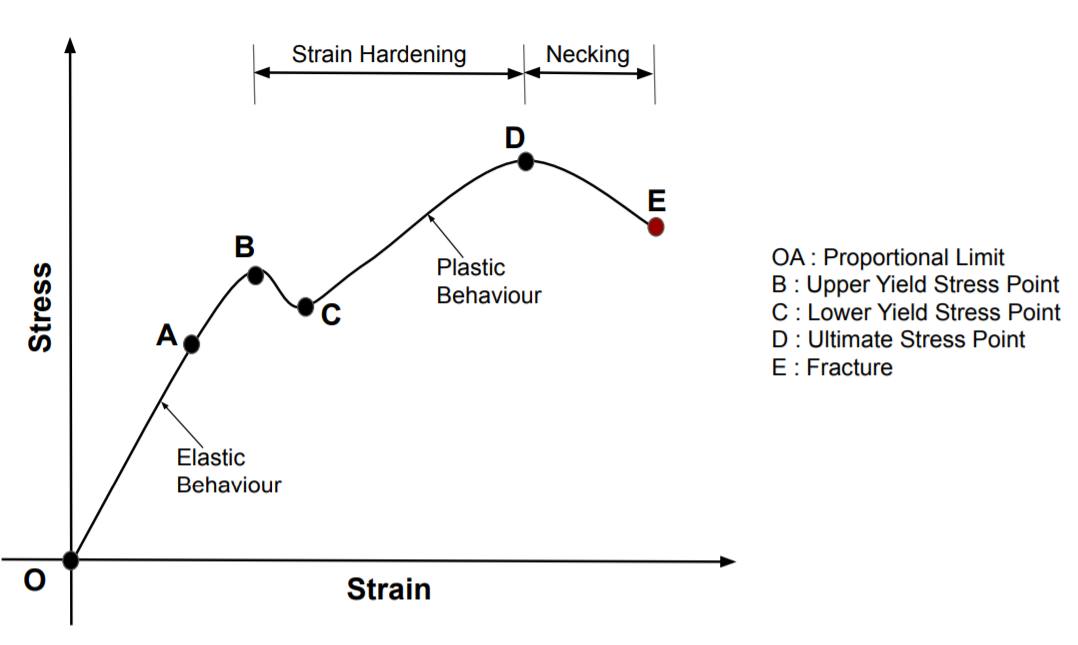
Ever look at a piece of metal, maybe a paperclip you're idly bending, and wonder what kind of drama is unfolding inside? Well, buckle up, buttercup, because materials have a whole secret life, and we map it out with something called a Stress-Strain Curve. Sounds super serious, right? Nah, it's actually like reading the emotional rollercoaster of a material, from its happy-go-lucky youth to its ultimate demise. And trust me, it's way more fun than it sounds!
Think of it as a material's autobiography, told in lines and squiggles. We're gonna stretch it, squish it, and see what happens. It’s basically a controlled interrogation, but for steel beams and plastic fantastic. Let's dive into the fascinating chapters of this quirky tale!
The Happy-Go-Lucky Elastic Region: Always Bounces Back!
First up, we have the elastic region. This is where the material is still playing nice. You pull it, it stretches; you let go, it snaps right back to its original shape. Like a rubber band doing its job! This area shows us how stiff a material is, which engineers call Young’s Modulus. Imagine trying to stretch a cooked spaghetti noodle versus a steel rod. Big difference, right? That’s Young’s Modulus in action! For a while, the stress (the force we’re applying) is directly proportional to the strain (how much it stretches). This is Hooke's Law – a true classic in material science!
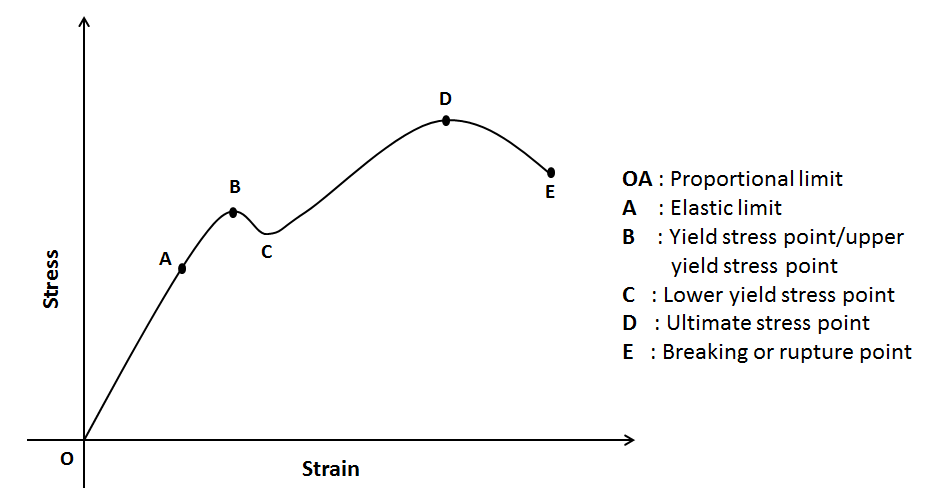
Within this region, there's the proportional limit, where that straight line starts to curve ever so slightly. Then the elastic limit, the absolute last point where the material can return to its original shape. Cross this line, and things get a little permanent. It’s like when you stretch a spring too far, and it just… stays stretched. A little sad, but fascinating!
The Yield Point: The Material Says, "I Give Up!"
Ah, the yield point. This is a big one! It's the moment the material says, "Okay, I'm done playing nice. I'm permanently changing." Imagine stretching a piece of chewed gum. For a while, it bounces back. Then, suddenly, it just gives and starts to stretch out easily, staying in its new, elongated form. That "giving" moment? That's the yield point! The yield strength is a critical number for engineers, telling them how much stress a material can handle before it deforms permanently. It's like the weight limit on a bridge – cross it, and you've got problems!
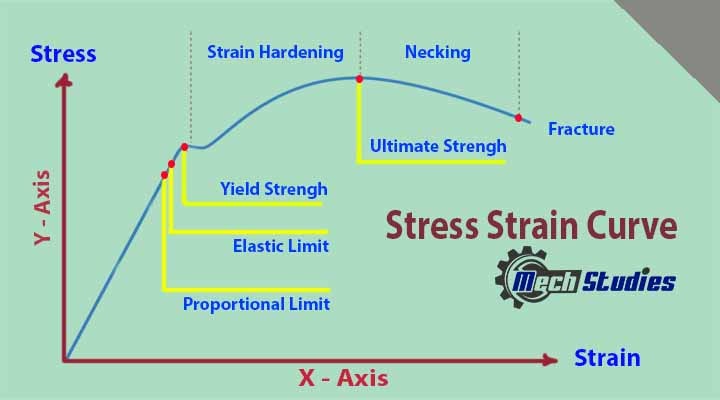
Fun fact: Some materials have a dramatic upper yield point (a little peak) and then a lower yield point (a dip) before settling into their plastic deformation. It’s like the material takes a deep breath, makes a little protest, then reluctantly accepts its fate. Quite the drama queen!
The Plastic Region: New, Stronger Me! (For a Bit)
Once past the yield point, we enter the plastic region. Here, the material is undergoing permanent deformation. It's like Play-Doh – you stretch it, it stays stretched. But here’s the cool part: as you keep pulling, the material often gets stronger! This is called strain hardening or work hardening. It's like going to the gym and building muscle. The internal structure of the material is changing, rearranging itself to resist further deformation. Pretty neat, huh? It's literally making itself tougher under duress!
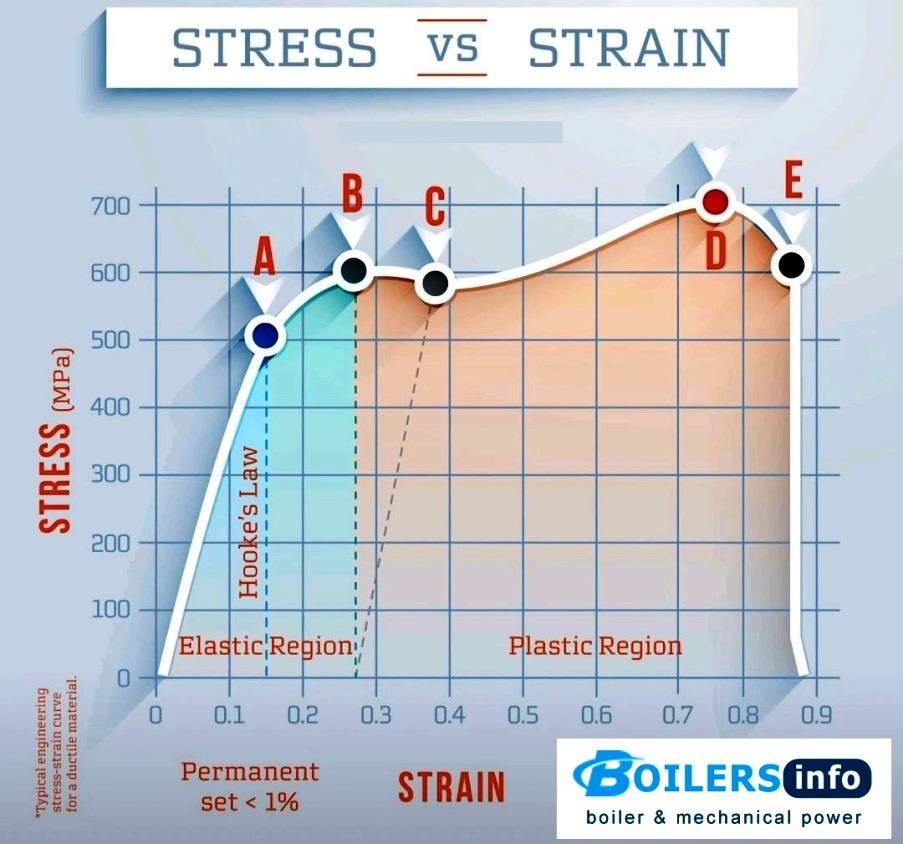
So, even though it's permanently changing shape, it's putting up a good fight and becoming more resistant to breaking. For a while, anyway. It's got that "what doesn't kill me makes me stronger" vibe going on.
Ultimate Tensile Strength (UTS): The Peak of Performance!
Keep pulling! Eventually, you'll reach the Ultimate Tensile Strength, or UTS. This is the absolute maximum stress the material can withstand. It's the peak of the curve, the material's last heroic stand. Imagine pulling on a rope until it's stretched to its absolute limit, just before it starts to fray visibly. That maximum tension before things visibly start to go downhill? That’s UTS. Engineers love this number too, because it tells them the absolute breaking point. It’s the material's moment in the spotlight, where it shows its greatest resistance before the inevitable.
Necking: The Material Gets a "Thin Neck"
After UTS, something visually fascinating happens, especially with ductile materials like metals. The material starts to thin out in one localized spot, forming what looks like a tiny hourglass or, well, a neck. It's like a balloon before it pops, getting thinner and thinner in one spot. This is called necking. What’s quirky here is that on the stress-strain curve, the engineering stress (which is calculated using the original cross-sectional area) actually starts to go down even though the material is getting stronger in that specific, thinning neck region. It’s a bit of a mathematical illusion, but a crucial one for understanding how materials fail.
Fracture Point: The Grand Finale!
And finally, the dramatic conclusion: the fracture point. This is where the material snaps, breaks, or tears apart completely. It's the mic drop moment for our material. This can happen in two main ways: ductile fracture, where the material stretches a lot and necks significantly before breaking (think a taffy pull), or brittle fracture, where it just snaps with little to no warning or deformation (like breaking a piece of glass). Both ends are equally final, but one offers a bit more suspense!
So there you have it! The epic journey of a material, told through the twists and turns of a stress-strain curve. From stretching happily, to yielding dramatically, to getting stronger, hitting its peak, necking down, and finally, fracturing. It’s a story full of science, drama, and some surprisingly quirky facts. Who knew materials had such fascinating lives? Next time you bend a paperclip, you’ll know you’re witnessing a tiny, tiny stress-strain curve playing out in your hands. Pretty cool, right?
