Hey there, fancy seeing you here! Grab a cuppa, pull up a chair. So, you know how when you're staring at your slicer, ready to hit print, and that little thought pops into your head?
It's the age-old 3D printing query, the one that whispers, "Is PETG more flexible than PLA?" Am I right? It's a question that feels like it should have a super straightforward answer, but then you start digging, and suddenly you're in a rabbit hole of materials science. But don't you worry, we're gonna chat through it, nice and easy, just like friends do.
PLA: The Go-To, But Kinda Stiff, Buddy
Let's start with our good old dependable pal, PLA. Bless its heart, it's the darling of the 3D printing world, isn't it? Easy to print, smells vaguely of pancakes sometimes (bonus!), and it makes truly gorgeous prints. For display pieces, prototypes, things that just need to sit there and look pretty? Chef's kiss.
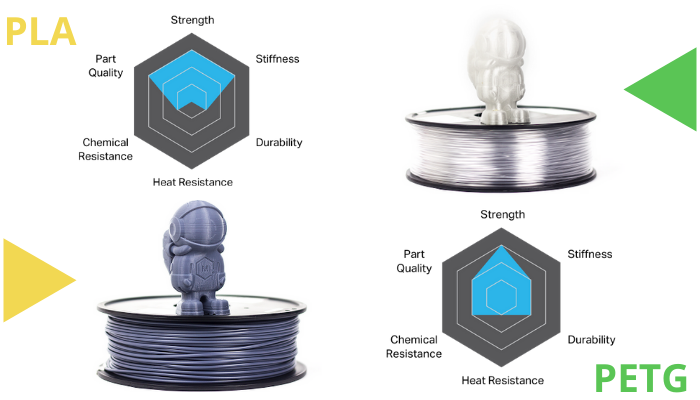
But here's the thing about PLA: it's a bit of a rigid fellow. Think of it like a really crisp cracker. It's strong, yes, but if you bend it even a little too much, what happens? Snap! Right? It's got great tensile strength, meaning it resists being pulled apart, but its impact resistance and ability to bend gracefully? Not its strong suit. It tends to be brittle. Very brittle, in fact. You drop a PLA print, and there's a good chance it's going to crack or even shatter.
So, when people talk about PLA's "flexibility," they usually mean its lack thereof. It holds its shape wonderfully, until it just... doesn't anymore. Sad face.
PETG: The Tougher, Bendier Cousin
Now, enter PETG. This guy is like PLA's slightly cooler, more adventurous older cousin. It's quickly becoming a favourite for functional parts, and for good reason. It's tougher, more durable, and generally, well, a bit more forgiving.
When you handle raw PETG filament, or even a finished PETG print, you immediately notice a difference. It feels a bit softer, a bit more... plastic-y in the way you'd expect a durable plastic item to feel. Think about a regular plastic water bottle – that's PET, a close relative. It doesn't just snap, does it? It deforms, it creases, it holds up.
PETG has excellent layer adhesion, often better than PLA, meaning its layers stick together like super glue, which contributes hugely to its overall strength. It also has better temperature resistance and chemical resistance. So, it's clearly a step up in a lot of ways.

The Million-Dollar Question: Is it More Flexible?
Alright, drumroll please! So, is PETG actually more flexible than PLA? The short, sweet answer, without getting bogged down in material science textbooks, is generally: Yes!
But here's the important nuance, because "flexible" can mean a few things, right? PETG isn't like TPU, which is rubbery and squishy. No, no. PETG is "flexible" in the sense that it is significantly less brittle than PLA. Where a PLA part would snap cleanly, a PETG part is more likely to bend, deform, or stretch a bit before it actually breaks. It's got much better impact resistance and ductility.

Imagine a thin wall. If it's PLA, give it a good push, and it'll probably crack. If it's PETG, that same wall will likely bend significantly further, absorbing the force, before it finally gives way. It’s about its ability to yield rather than fracture.
So, you get a stronger part overall, one that can take a bit more abuse without instantly failing. That makes it incredibly valuable for things like drone parts, tool holders, phone cases, or anything that might experience a bump or a squeeze.
When To Choose Which, My Friend?
So, when does this knowledge come in handy?
- If you're printing a cute little decorative statue for your desk, a board game piece, or a prototype that just needs to look the part? PLA is your guy. It's easy, it's fast, and it looks great.
- If you're printing something that needs to be functional, something that will be handled a lot, dropped, used outdoors (PETG handles UV better too!), or needs to absorb some impact? You absolutely want to lean towards PETG. Think functional brackets, parts for your printer, outdoor garden gnomes (kidding, but also, maybe?), or anything that needs a bit of a tough skin.
Remember, printing PETG can be a tiny bit trickier than PLA – it loves to string, for example, and needs higher temperatures. But once you dial it in, the results are seriously worth it for those tougher applications.
So there you have it! PETG isn't going to be stretching like a rubber band, but it's definitely going to bend, flex, and endure far more than our brittle friend PLA before it calls it quits. It's all about choosing the right tool for the right job, isn't it?
Now, about that refill? We could totally talk about infill next time...