
Okay, let's talk about air conditioners. Not the glorious, icy blasts when you first walk into a perfectly chilled room on a sweltering day – we all love those. But rather, the often-overlooked, yet utterly crucial, part of the AC journey: sizing it correctly.
I remember one summer, years ago, when my partner and I moved into a new place. It was a charming little bungalow, but man, did it get hot. Our solution? "Bigger is better, right?" we thought, gleefully installing what we believed was a powerhouse window unit. For about 10 minutes, it felt like a dream. Then, it would click off, leaving us to slowly simmer back to discomfort before it grudgingly kicked back on for another brief, icy burst. Our place was either an arctic tundra or a swampy sauna, with no in-between. And the electricity bill? Don't even get me started.
Sound familiar? You've probably experienced something similar, either with an AC that just couldn't keep up, or one that felt like it was playing a very aggressive game of on-again, off-again. Turns out, we were victims of a common misconception: that you can just eyeball it, or that overcompensating will solve all your problems. And let me tell you, it absolutely, positively does not.
Why Sizing Matters (Seriously, It's a Big Deal)
Imagine buying shoes. If they're too small, they pinch, hurt, and you want to rip them off your feet. If they're too big, you trip, they flop around, and you're just not comfortable. An AC unit is kind of like that, but with your entire house's comfort and your wallet at stake.
Too Big: The "Overkill" Problem
If your AC unit is too powerful for your space, it's going to cool your house super fast. Sounds good, right? Wrong. When an AC cools too quickly, it satisfies the thermostat setting before it's had enough time to properly dehumidify the air. This leads to that clammy, sticky feeling even when the temperature is technically cool. It also leads to "short cycling," where the unit constantly turns on and off, wasting energy, increasing wear and tear on components, and hiking up your energy bills. Plus, that constant clicking on and off? Annoying.

Too Small: The "Underpowered" Predicament
On the flip side, an AC that's too small is like trying to cool a ballroom with a single fan. It will run constantly, never quite reaching your desired temperature, especially on the hottest days. This isn't just uncomfortable; it also means your unit is working overtime, shortening its lifespan, and still running up those energy bills because it's never truly efficient. It's just fighting a losing battle, and you're paying for the show.
How We Measure AC Power: BTUs!
Before we dive into the nitty-gritty, let's talk about the unit of measurement for AC power: BTUs. That stands for British Thermal Units, and it basically tells you how much heat an AC unit can remove from a space in an hour. Think of it as the air conditioner's muscle. More BTUs mean more cooling power.
The Rough-and-Ready Estimate (The Starting Point, Not The Finish Line!)
Okay, so how do you figure out the right number? A very, very basic rule of thumb is to estimate 20-25 BTUs per square foot of living space. So, if you have a 1,000 square foot home, you'd be looking for something in the range of 20,000 to 25,000 BTUs.

But here's where it gets interesting, because that's just a starting point. Your home isn't a generic box. It has personality, quirks, and factors that drastically change its cooling needs.
Factors That Turn That Rough Estimate Into a Science Project
This is where you need to put on your detective hat, because your house is giving you clues!
-
Your Climate: Live somewhere scorching hot and humid, like Florida or Houston? You'll need more BTUs per square foot than someone in a milder climate. Humidity removal needs power!
-
Insulation (Or Lack Thereof): Is your home well-insulated? Fantastic! Less heat sneaking in means less work for your AC. Older homes with poor insulation, on the other hand, will need more power to combat the constant heat gain. This is huge.
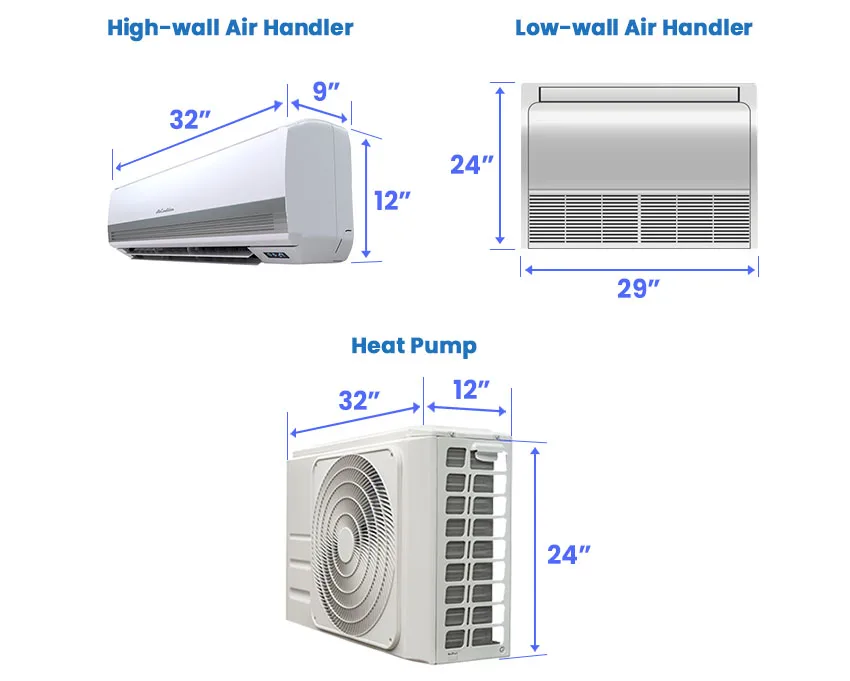
Air Conditioner Dimensions (Standard Unit Sizes) - Designing Idea -
Windows, Windows, Windows: Do you have a lot of windows? Are they single-pane or energy-efficient double-pane? Do they face south or west, getting blasted by the afternoon sun? All these mean more heat gain, thus more BTU requirements. Consider shading them!
-
Ceiling Height: A room with 10-foot ceilings has more air volume to cool than one with 8-foot ceilings, even if the square footage is the same. Factor that in!
-
Occupants: Each person in your home generates heat. A bustling family of five needs more cooling power than a single person living alone. (Shocking, I know! We're all little heaters).
-
Heat-Generating Appliances: A kitchen that's constantly cooking, a laundry room, or even lots of electronics can add significant heat to your home. Think about those gaming PCs!
:max_bytes(150000):strip_icc()/air-conditioning-chart-1152654_final-02-c37c8b4fdf08432baf378e8f0cb9d8e0.jpg)
How To Calculate The Room Size For An Air Conditioner: Expert Tips - AC -
Shade: Does your house have good natural shade from trees or overhangs? Or is it baking in direct sunlight all day? The sun is a powerful opponent!
The Gold Standard: Manual J Calculation
While those factors give you a much better idea, the absolute best way to properly size an AC unit is through something called a Manual J calculation. This is a detailed load calculation performed by HVAC professionals. They input all those factors (and more!) into specialized software to get a precise BTU requirement for your specific home.
It’s not something you can easily do yourself with a quick Google search. This is where calling in the pros really pays off, because they'll ensure you get a system that's just right – not too big, not too small, but perfectly tailored for your comfort and energy efficiency.
Trust me, after years of freezing one minute and sweating the next, I can tell you that getting the size right for your AC unit is one of the smartest decisions you can make for your home comfort and your utility bills. Don't eyeball it; get it right!